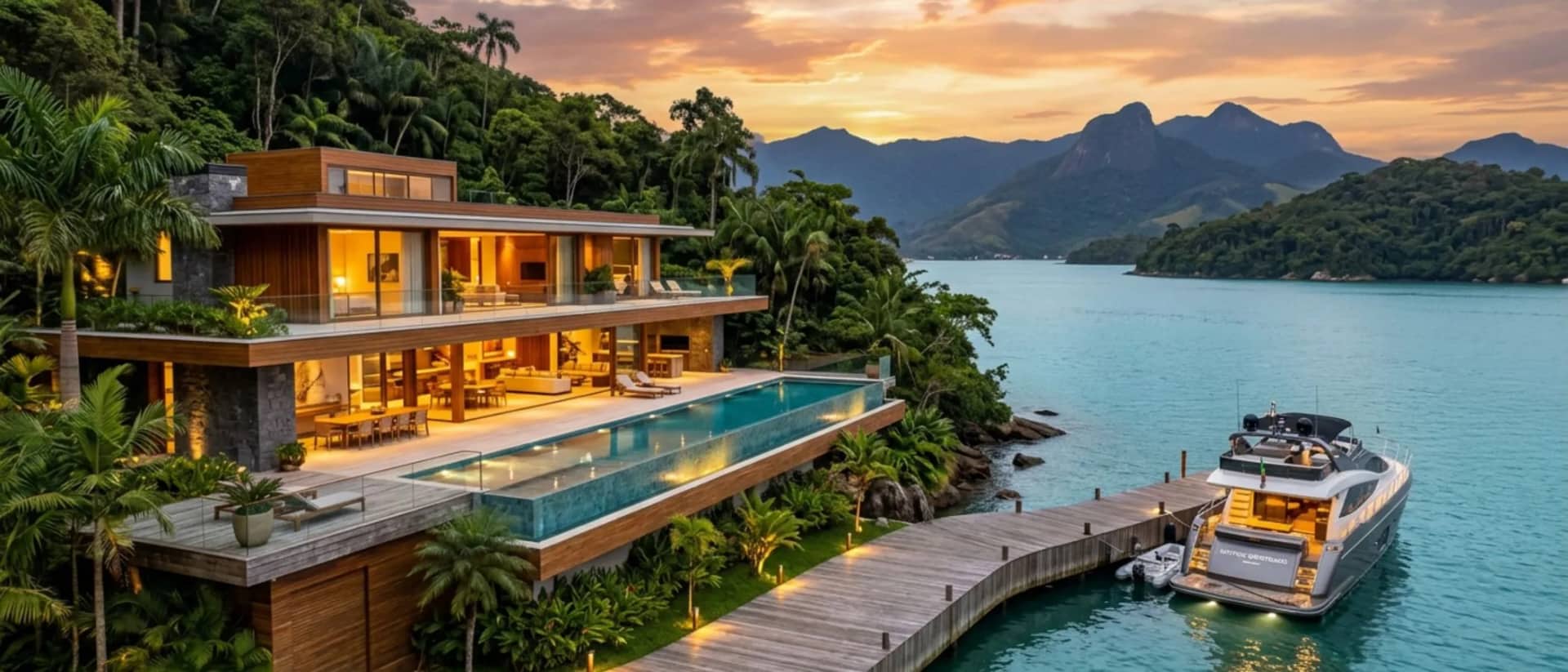

The Costa Verde region of Rio de Janeiro, with its unique geography of 365 islands and emerald-colored sea, has established itself as the laboratory of high-end Brazilian tropical architecture. In Angra dos Reis, residences are not just houses; they are artistic manifestations that seek complete integration between the Atlantic Forest and nautical life.
1. Masters of Tropical Architecture
Angra has attracted the most prestigious names in national and international architecture, who adapted modernism to the region’s climatic and visual conditions.
Bernardes Arquitetura: Claudio Bernardes (and now his son, Thiago) is perhaps the most emblematic name in the region. Their works are known for large thatched or wooden roofs, lightweight structures, and the elimination of visual barriers between the living room and the sea.
Indio da Costa: Responsible for projects that challenge topography, such as the famous Residência Angra, where landscaping and architecture fuse into garden slabs.
Paulo Mendes da Rocha: The Pritzker Prize winner left his mark with the Casa Gerber, conceived as an "extroverted tent," using raw concrete to frame nature.
Jacobsen Arquitetura: Paulo Jacobsen is a reference for "barefoot luxury," using transparency and natural materials to create homes that seem to float above the water.
2. Enclaves of Exclusivity
Angra’s gated communities act as open-air showcases for these masterpieces.
Porto Frade
Considered the benchmark for nautical luxury, Porto Frade combines the lifestyle of the Fasano Hotel with a system of navigable canals that allows owners to dock their yachts right at their doorstep. The architecture here is diverse, ranging from traditional rustic-chic to minimalist contemporary mansions overlooking the golf course.
Portogalo
Famous for its security and the cable car connecting the houses to the beach, Portogalo stands out for its hillside constructions, providing spectacular aerial views of Ilha Grande. It is a place where architecture prioritizes the “private lookout.”
Porto Bello (Mangaratiba)
Although technically in Mangaratiba, Porto Bello is an immediate neighbor and shares the same luxury ecosystem. It is the only one with its own safari and private airstrip. Its homes tend to be monumental, occupying vast plots focused on total leisure: helipads, tennis courts, and private marinas.
3. Elements of the "Angra" Design
Architecture on the Costa Verde is governed by four pillars:
Transparency: Massive use of glass to capture every angle of the sea.
Organic Materials: Reforested wood, local stones, and natural thatch to ensure thermal comfort.
Navigability: Decks that are not only aesthetic but functional for large vessels.
Cross Ventilation: Designs that eliminate the need for air conditioning in common areas by taking advantage of the bay’s constant breeze.