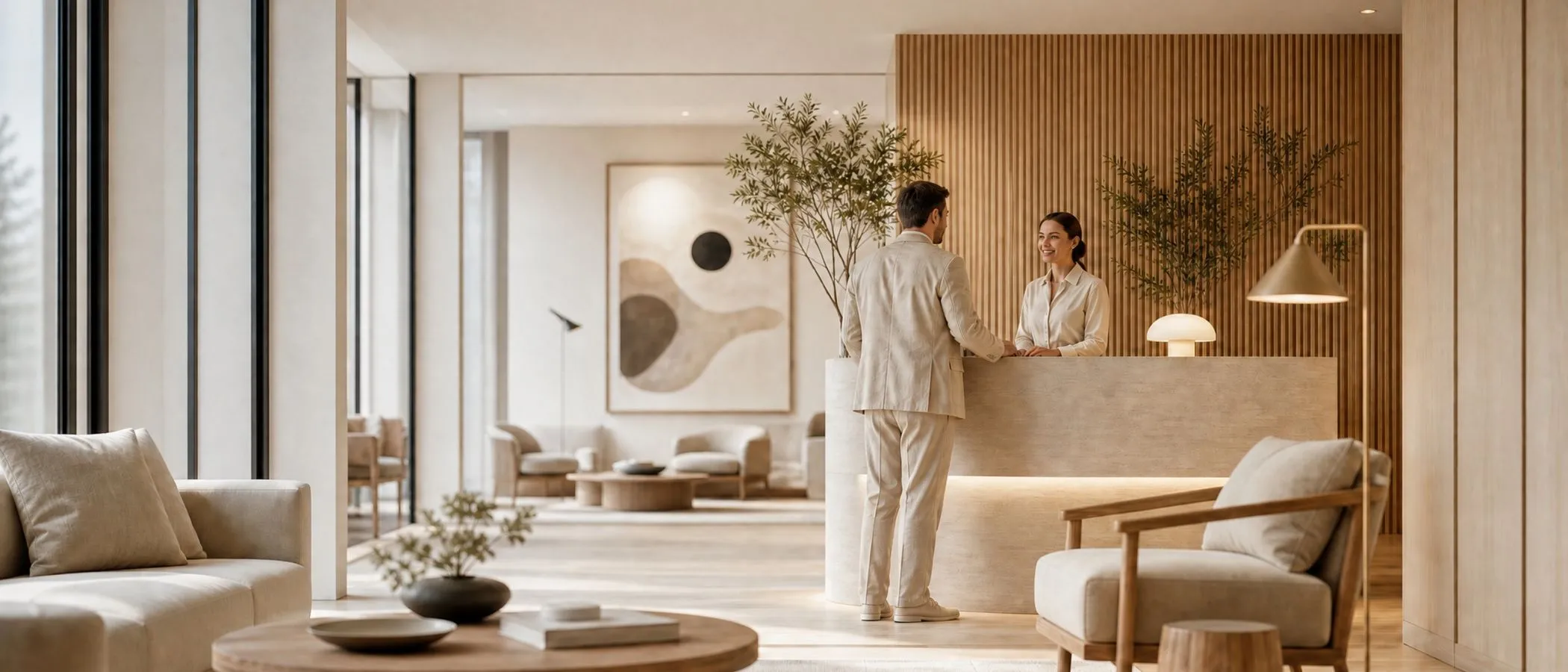

Luxury hospitality is increasingly the axis that reorganizes the logic of contemporary luxury. For decades, the luxury market has been mainly associated with rarity, heritage, artisanal excellence, and status symbols. However, this universe is undergoing a profound transformation. In a landscape marked by technological acceleration, AI in luxury, automation, and hyperconnectivity, an increasingly relevant international debate is growing: the true competitive edge of future luxury may lie precisely in the value placed on human relationships.
In the era of automation, quality service reinforces the value of exclusive experiences.
Luxury hospitality as a strategy
In this context, hospitality no longer occupies only an operational role tied to service and is now understood as a strategic, symbolic, and emotional element within premium experiences. More than serving, high-end hospitality means welcoming, perceiving, anticipating desires, building a sense of belonging, and creating genuine connections between brands and people.
This movement helps explain the role of hospitality in the luxury of the future. Rather than acting as a complement to delivery, it begins to shape the very perception of value. This applies to hotels, brands, restaurants, premium retail, and exclusive experiences, which are increasingly recognizing that technical excellence alone is no longer enough.
Customer experience in luxury and value creation
At the center of this shift is the customer experience in luxury. Today’s consumer seeks emotionally meaningful experiences capable of creating lasting memories, well-being, individual recognition, and a sense of belonging. In this environment, what sets a brand apart is not just the consumption object itself, but how the individual feels while experiencing a given moment.
For this reason, hospitality gains importance as a brand language and relational practice. It conveys care, attention to detail, and a sensitive reading of context. It also expands the ability to transform a sophisticated service into a memorable experience.
Human relationships in luxury and the theoretical context of this transformation
To understand why this shift matters to the contemporary luxury market, it is worth looking at references that help explain the strength of the relational dimension. Authors such as Lashley view hospitality as a social and relational phenomenon, while Lugosi expands this view by discussing experiences capable of creating emotional and memorable bonds.
In the luxury world, this perspective becomes even more relevant, as high-income consumers already have broad access to products, technology, and sophisticated services. Thus, human relationships in luxury take on growing strategic importance. What creates differentiation is not only the offering itself, but the quality of the bond built לאורך the journey.
Technology and artificial intelligence in luxury
At the same time, there is growing digital fatigue and an excess of automated stimuli in contemporary relationships. While artificial intelligence positively transforms efficiency, personalization, and data management, it also intensifies a counter-movement. This movement is the search for presence, active listening, sensitivity, authenticity, and meaningful human interaction.
This is a central point for understanding how artificial intelligence impacts luxury hospitality. Technology expands operational capacity and precision. At the same time, it highlights what it cannot fully replace: the subjective reading of the moment, the delicacy of human presence, and genuine hospitality.
Luxury, historically associated with time, extreme care, and attention to detail, finds in this scenario a strategic opportunity for repositioning. Instead of competing solely on technical sophistication, it can reaffirm its value through experiences in which the human element enhances the use of technology.
Contemporary luxury in a hybrid logic
More than sophisticated automation, contemporary luxury seems to be moving toward a hybrid logic. In it, technology and artificial intelligence serve as operational support. The human element, in turn, becomes responsible for building emotion, sensitivity, and symbolic experience.
In this arrangement, attributes such as empathy, cultural background, genuine listening, relational sophistication, and extreme care take on growing strategic value within organizations. It is also at this point that it becomes clearer why the human element is a differentiator in the luxury market.
The human as a competitive edge in luxury hospitality
It is therefore clear that hospitality should no longer be seen merely as a complementary attribute of luxury, but as a fundamental competitive asset in a market increasingly driven by experience, emotion, and human connection. In a highly technological future, perhaps the true luxury will be precisely what cannot be automated: the human ability to create authentic bonds, genuine hospitality, and deeply memorable experiences.
Direct answer: hospitality as a competitive advantage in luxury
Hospitality as a competitive advantage in luxury is gaining strength because it combines strategy, emotion, and perceived value. In an increasingly technological market, artificial intelligence tends to increase efficiency, but it is human presence that sustains belonging, recognition, and emotional memory.
For this reason, luxury hospitality is establishing itself as a central asset of the future. As automation and hyperconnectivity advance, the value of experiences in which human care is perceived as rare, authentic, and irreplaceable tends to grow.