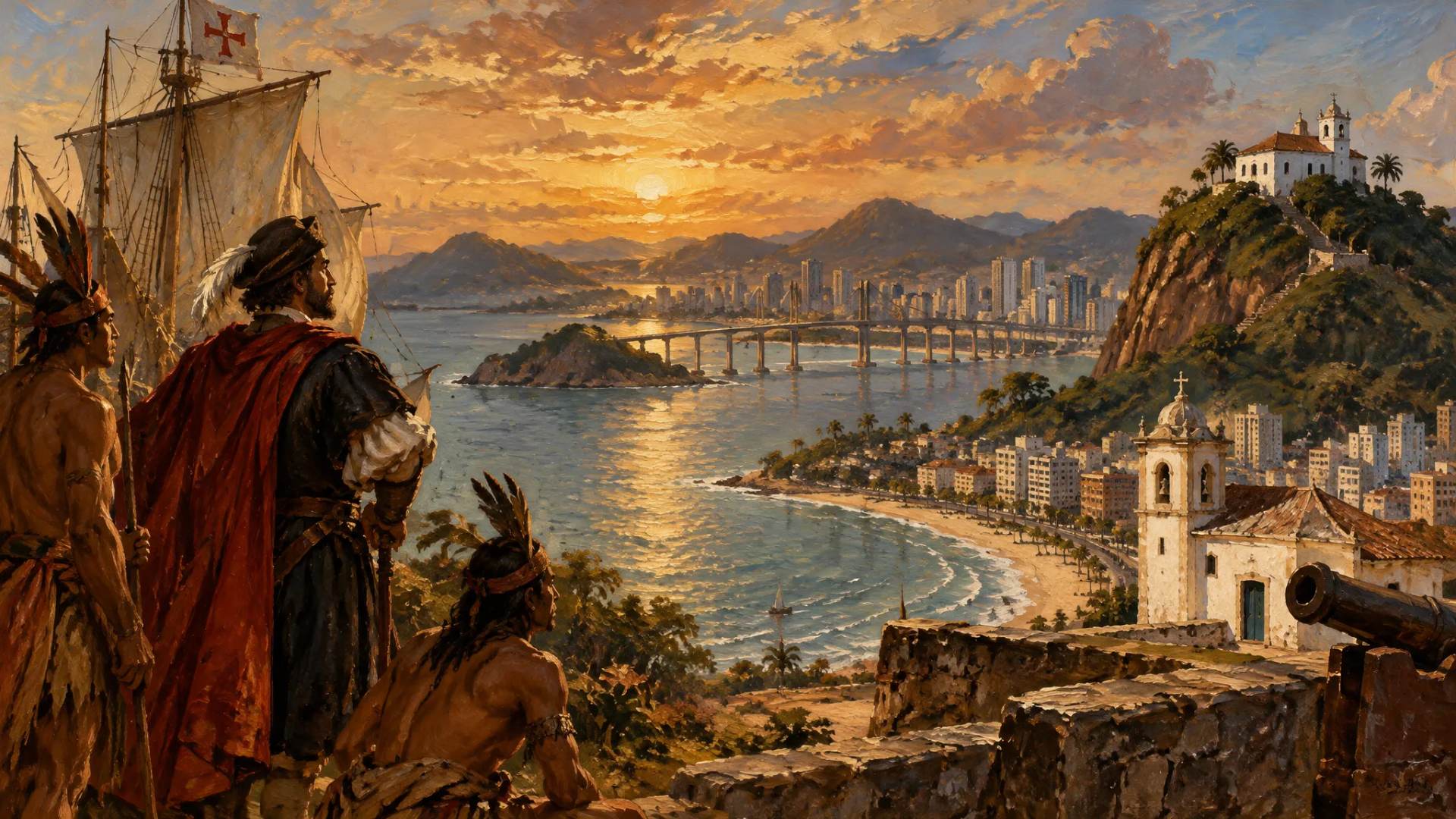

Vila Velha, in Espírito Santo, is much more than a city of beautiful beaches and natural landscapes. It is a place where Brazil’s history meets modernity, where centuries-old traditions coexist with new developments, urban growth, and a population that increasingly values quality of life.
Considered the oldest city in Espírito Santo, Vila Velha has a history that began in the 16th century, spans important moments in the state’s formation, and continues today as one of the leading municipalities in the Greater Vitória Metropolitan Region.
Getting to know Vila Velha means understanding an important part of Espírito Santo’s history and discovering how a small colonial settlement became a dynamic, sought-after city full of opportunities.
The arrival of the Portuguese and the beginning of colonization – 1535
Vila Velha’s history officially began on May 23, 1535, when Portuguese explorer Vasco Fernandes Coutinho landed in the area of what is now Prainha, accompanied by approximately 60 settlers aboard the caravel Glória.
At the time, the land was already inhabited by Indigenous peoples, including the Tupiniquim, Goitacá, and other groups, each with their own cultures, customs, and forms of organization.
Vasco Fernandes Coutinho had received the Hereditary Captaincy of Espírito Santo from the Portuguese Crown and arrived with the mission of settling and governing the territory.
Because the landing took place during the Pentecost celebrations, the region was named Espírito Santo, or Holy Spirit. The first Portuguese settlement in the territory was established there, initially called Vila do Espírito Santo.
The Prainha area thus became the historic landmark of Portuguese colonization in Espírito Santo.
Vila Velha and the transfer of the capital
The early years of colonization were marked by hardship, conflicts with Indigenous peoples, and the threat of foreign invasions.
Faced with security concerns and difficulties defending the area, Vasco Fernandes Coutinho decided in 1549 to move the administrative center to a nearby island, where the present-day city of Vitória developed.
The new settlement was named Vila Nova do Espírito Santo, while the original settlement came to be known as Vila Velha.
This move marked the beginning of a new chapter in the history of both cities. Separated by Vitória Bay, they went on to play complementary roles in the development of Espírito Santo.
Even after the administrative center moved, Vila Velha retained its historical importance and continued to be one of the main centers shaping Espírito Santo’s identity.
Penha Convent and the enduring strength of religious tradition
One of the most important events in Vila Velha’s history was the arrival of Friar Pedro Palácios in 1558.
The Spanish friar settled in the area and began building what would become the Convent of Our Lady of Penha, now one of Espírito Santo’s greatest religious and tourist landmarks.
Built atop a cliff, the convent became a notable example of colonial religious architecture and one of Brazil’s most important Marian shrines.
In addition to its religious significance, the site offers one of the region’s most beautiful views, overlooking Vila Velha, Vitória, the Third Bridge, Vitória Bay, and the Espírito Santo coast.
The traditional Festa da Penha, held every year, draws thousands of worshippers and visitors, keeping a generations-old tradition alive.
Another highly significant historic landmark is the Church of Our Lady of the Rosary, located in Prainha and dating back to the early years of colonization.
From the colonial economy to urban development
For the first few centuries, the region’s economy was closely tied to agriculture, particularly sugar production, with sugar mills established throughout the area.
Over time, Vila Velha underwent economic and social changes in step with the development of Espírito Santo.
Its proximity to Vitória, strategic location, and natural advantages supported the growth of commercial, port, and industrial activities.
In the 20th century, the municipality began to experience more substantial urban expansion. New roads, growing economic activity, and population growth contributed to the development of new neighborhoods and closer integration with the Greater Vitória Metropolitan Region.
The city gradually moved beyond its predominantly historic and rural character to take on an urban, commercial, and residential profile.
The beaches and identity of Vila Velha
If history is the soul of Vila Velha, its beaches are an important part of its lifestyle.
With approximately 20 miles of coastline, the municipality offers a variety of settings for people who enjoy nature, sports, leisure, and dining.
Some of the best-known beaches include:
Praia da Costa: one of the city’s most sought-after areas, with excellent amenities, a beachfront promenade, restaurants, shops, and residential buildings.
Itapuã: known for its inviting atmosphere, restaurants, kiosks, and proximity to services and shops.
Itaparica: an area experiencing strong real estate growth, with modern condominiums, residential developments, and a popular waterfront.
Itapoã Beach and nearby areas: offer leisure options, walking, sports, and places to gather.
Barra do Jucu: retains its traditional character, with a strong cultural identity, local cuisine, artisanal fishing, and folk traditions.
Praia da Sereia: a well-known stretch of coastline with scenic views that draw residents and visitors.
Vila Velha’s beachfront is part of everyday life for its residents. Walks, runs, cycling, surfing, footvolley, and seaside gatherings all contribute to a lifestyle that combines health, recreation, and well-being.
Culture, cuisine, and traditions
Vila Velha also has a rich cultural identity.
The city preserves traditional expressions such as congo music from Espírito Santo, especially in Barra do Jucu, where music, dance, and religious practices embody the state’s cultural heritage.
Food is another highlight. Restaurants and kiosks serve everything from traditional Espírito Santo cuisine, such as moqueca, to contemporary dishes and a variety of cuisines.
The municipality is also home to cultural venues, historic monuments, and events that enliven the tourism calendar and strengthen residents’ sense of belonging.
This combination of tradition and modernity gives Vila Velha a character all its own.
Vila Velha today: development and quality of life
Today, Vila Velha holds a prominent place in Espírito Santo’s economic and real estate landscape.
Its connections to Vitória, Cariacica, Serra, and other municipalities in Greater Vitória provide access to an extensive network of services, career opportunities, educational institutions, hospitals, shopping centers, and recreational activities.
The Third Bridge is a key link to the capital, making it easier for people to travel and supporting commercial and professional ties between the municipalities.
Retail is diverse, with shopping malls, supermarkets, schools, clinics, restaurants, gyms, and a broad network of services spread throughout the neighborhoods.
At the same time, the city continues to invest in infrastructure, urban mobility, development, and improvements to public spaces.
Vila Velha offers a range of housing options, from traditional neighborhoods with a strong local identity to high-density areas with modern condominiums, amenities, and upscale developments.
The real estate market and the city’s rising appeal
Vila Velha’s growth is also directly reflected in its real estate market.
Neighborhoods such as Praia da Costa, Itapuã, Itaparica, Praia de Itaparica, and Jockey de Itaparica appeal to families, investors, and people looking to live near the ocean without giving up urban amenities.
The Praia da Costa area stands out for its prime location, range of services, proximity to Vitória, and selection of properties across different price points.
Itapuã combines a longstanding residential character, established retail, and easy access to major roads across the city.
Itaparica, meanwhile, is experiencing a real estate boom, with new developments, modern condominiums, and options for a variety of buyers.
The market offers compact apartments, family homes, penthouses, ocean-view units, and developments with extensive recreational amenities.
For those looking to invest, move, or purchase their first home, Vila Velha offers appealing opportunities, particularly because of its diverse neighborhoods and lifestyles.
The future of Vila Velha
Vila Velha’s future depends on its ability to balance economic growth, environmental preservation, and appreciation of its historic identity.
The city has several strengths that support its development: a strategic location, an extensive coastline, a rich cultural heritage, a strong service infrastructure, and connections throughout the metropolitan area.
The challenge is to keep moving forward with thoughtful urban planning, efficient mobility, preservation of natural areas, and investment in public spaces.
More than simply increasing the number of developments, Vila Velha has an opportunity to strengthen what makes it special: its blend of history, nature, culture, and quality of life.
Conclusion: a city that brings the past, present, and future together
Vila Velha has more than four and a half centuries of history behind it, and it continues to write new chapters every day.
Portuguese colonization of Espírito Santo began in the area of what is now Prainha. The captaincy’s first administrative, religious, and economic structures were established there. And from this historic settlement grew one of the state’s most important cities.
Today, Vila Velha represents far more than its colonial past. It is a city of beaches, opportunities, dining, culture, real estate development, and quality of life.
Living in Vila Velha means enjoying the ease of life near the ocean, the convenience of an established urban infrastructure, and the benefits of living next to Espírito Santo’s capital.
Vila Velha is more than a city to visit. It’s a city to live in, invest in, and make your own history.